


Cart
0
-
Round tables are common in Indian homes, particularly in smaller apartments, eat-in kitchens, and dining spaces that need to seat four people comfortably without taking over the room. They are good tables. They encourage conversation because no one is sitting far from anyone else, they fit into corners and smaller rooms that a rectangular table cannot, and a well-dressed round table has a completeness to it that a rectangular one does not always achieve.
The challenge with a round table is that the styling logic is different from a rectangular one. There is no long axis. There is no obvious head of the table. A runner, the first thing most people reach for, does not work the same way. The centrepiece cannot be pushed to one end to make room for serving dishes. Everything is equidistant from the centre, which means the centre has to work harder than it does on any other table shape.
Once you understand the geometry, dressing a round table becomes considerably more straightforward.
Getting the Tablecloth Size Right
Before anything else, the tablecloth has to fit. A round tablecloth on a round table should drape evenly on all sides, with an equal drop all the way around. An uneven drop, where one side hangs lower than another, is the most common and most visible mistake in round table dressing.
How to measure: Start with the diameter of the table. Add twice the desired drop to that figure. That gives you the minimum diameter of the cloth you need.
For everyday casual use, a drop of 6 to 8 inches reads as relaxed and practical. For a standard dressed table at home, 10 to 12 inches is right. For a formal dinner party setting, 12 to 15 inches gives the table a more composed, occasion-appropriate look.
Quick reference for common Indian round table sizes:
A 36-inch round table (common two-seater breakfast table) with a 10-inch drop needs a cloth of at least 56 inches in diameter.
A 48-inch round table (standard four-seater) with a 10-inch drop needs a cloth of at least 68 inches.
A 54-inch round table (larger four to five seater) with a 10-inch drop needs a cloth of at least 74 inches.
A 60-inch round table (six-seater) with a 10-inch drop needs a cloth of at least 80 inches.
Always buy round for round. A rectangular cloth draped over a round table bunches at the points and hangs unevenly. There is no way to make it look right. A round cloth is the only cloth for a round table.
Printed Tablecloths Work Particularly Well on Round Tables
On a rectangular table, much of the tablecloth print disappears under the runner and the place settings. The centre strip of the cloth is where you see the pattern, and even that is partially obscured by whatever runs along it.
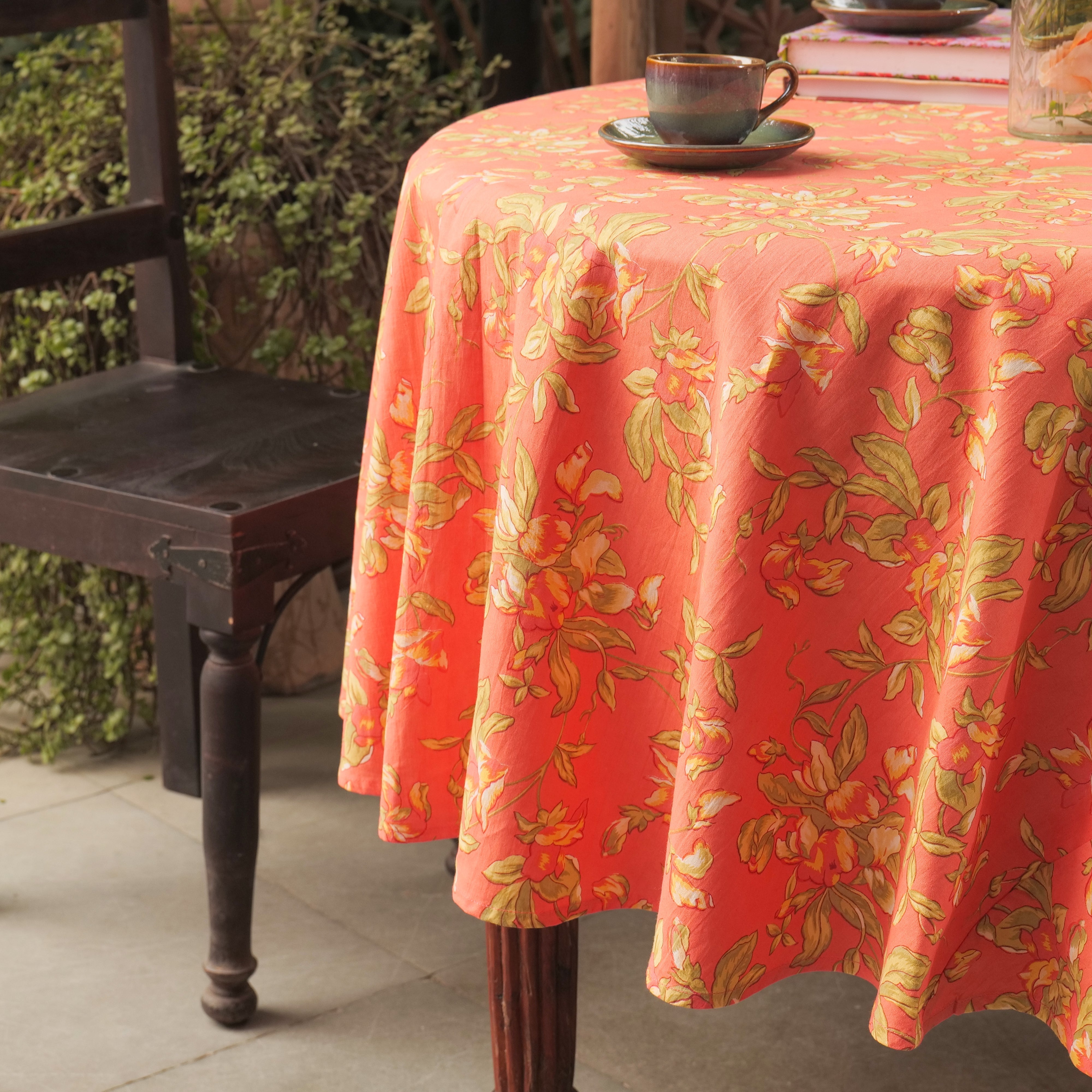
On a round table, the entire cloth is visible from all sides simultaneously. A floral or botanical print at a four-seater round table reads as a complete picture rather than a backdrop. This is why printed tablecloths tend to look their best on round tables, and why a cloth that might feel busy on a large rectangular table looks entirely right on a smaller round one.
For everyday use on a round table, a mid-scale floral or botanical print in warm corals, aquas, sage greens, or deep terracottas works well. The print is visible and appreciated, the scale suits the table, and the warmth of the colour palette coordinates with the food and the room.
For a festive round table, a richer print in jewel tones or traditional Indian motifs, paisleys, florals, or geometric repeats, gives the table a sense of occasion without requiring elaborate additional decoration.
Runners on Round Tables
The standard table runner laid lengthwise down a rectangular table does not translate directly to a round one. It extends past both ends of the table by 12 to 15 inches, which works when the table has two long ends. A round table has no long ends. A single runner laid across a round table looks stranded rather than intentional.
There are three approaches that work:
The crossed runner. Two runners laid at right angles over the tablecloth, one running in each direction, create a cross or grid pattern at the centre of the table. This divides the table into four quadrants, each with a natural serving zone. It looks composed from above and adds a second layer of colour and texture over the tablecloth. Use two runners in the same print and colourway, or in two complementary colours from the same palette.
The single runner as a feature. A single runner placed deliberately across the table, shorter than the diameter so it sits within the table rather than hanging over the edges, works as a centrepiece base rather than a structural element. Place the centrepiece along it and let the runner frame the centre zone rather than define the length of the table.
No runner, centrepiece directly on the cloth. On a round table with a strong printed tablecloth, no runner is needed at all. The print already does the decorative work. A centrepiece placed directly in the centre of the cloth, in a vessel that complements rather than competes with the print, is clean and complete.
Centrepieces for Round Tables
The centrepiece on a round table sits at the geometric centre and is visible from every seat simultaneously. This is different from a rectangular table where the centrepiece is primarily seen from the sides and can be partially obscured from the ends.
The visibility from all sides has two implications. First, the centrepiece needs to look good from every angle, not just from the front. Second, it needs to be low enough that it does not become a wall between the guests sitting around the table.
The height rule for round tables is more important than for rectangular ones. On a rectangular table, a taller centrepiece at the centre does not obstruct the view between guests at the sides. On a round table, where guests sit in an arc around the cloth, anything above ten to twelve inches starts to interrupt sightlines.
Centrepiece options that work well on round tables:
A low, wide-mouthed bowl or vase with seasonal flowers cut short, so the arrangement sits at or below the rim of the vessel. Marigolds, dahlias, or seasonal Indian blooms in a terracotta or ceramic bowl looks exactly right.
A cluster of candles in varying heights, kept under ten inches, scattered symmetrically around the centre. Three or five candles look better than two or four on a round table because odd numbers avoid the bilateral symmetry that can feel rigid.
A flat basket or shallow bowl with seasonal fruit. Mangoes, lychees, and passion fruits in their natural colours provide everything a centrepiece needs: colour, scale, and the suggestion of abundance.
A single statement object, a wide ceramic vessel, a carved wooden bowl, a beautiful piece of earthenware, placed at the centre with nothing around it. On a printed tablecloth, a singular object at the centre is often more powerful than a composed arrangement.
Placemats on a Round Table
The placemat question on a round table comes down to available space. A four-seater round table at 48 inches has less surface area per guest than a six-seater rectangular one. Placemats need to be sized and positioned carefully or they crowd the centrepiece and each other.
Placement: Position each placemat with the outer edge one inch from the table edge, centred directly in front of each chair. On a round table, this means the placemats radiate out from the centre like the spokes of a wheel. The inner edges of the placemats should leave a clear central zone of at least 12 to 14 inches in diameter for the centrepiece.
Shape: Rectangular placemats work well on round tables and are the most widely available. The contrast between the rectangular mat and the curved table edge creates a clean, considered look. Oval placemats also work and echo the curves of the table more softly.
Coordination: On a printed tablecloth, plain placemats in a colour pulled from the print keep the table from becoming visually busy. On a plain tablecloth, a placemat with a subtle print or texture adds interest at each setting.
Styling a Round Table for Different Occasions
Everyday family meals: A printed cotton tablecloth, four fabric placemats in a coordinating colour, and simply folded cloth napkins on each plate. Centrepiece optional: a bowl of seasonal fruit on the cloth works without any additional arrangement.
Dinner with guests: The same printed cotton tablecloth with a crossed runner in a deeper colourway over it. Fabric placemats and properly folded napkins at each setting. A low centrepiece of fresh flowers at the intersection of the two runners.
Festive occasions: A rich printed tablecloth in a jewel tone or traditional Indian motif. No runner needed: the cloth carries the occasion. Placemats in a plain deep tone that picks up one colour from the cloth. A cluster of candles or a terracotta bowl of seasonal flowers at the centre. Cloth napkins in a warm, festive print folded at each setting.
A small breakfast table for two: A plain or lightly printed tablecloth, two placemats, two napkins, and nothing at the centre. The simplicity is the point. A round breakfast table dressed with restraint looks considered and welcoming in a way that a heavily styled one does not.
The One Mistake to Avoid
The most common mistake on a round table is treating the centrepiece as if it were on a rectangular table, placing it too tall, too far to one side, or as if it needs to run along an axis that does not exist.
A round table has no axis. Everything radiates from the centre. The centrepiece goes in the centre, sits low, and looks good from all sides. The placemats radiate from that centre. The napkins complete each setting.
That is the geometry of a round table, and once it is clear, every styling decision follows from it naturally.
Frequently Asked Questions
What size round tablecloth do I need for a 4-seater round table? A standard four-seater round table in an Indian home has a diameter of approximately 48 inches. With a 10-inch drop on all sides, you need a round tablecloth of at least 68 inches in diameter. For a more formal look with a 12-inch drop, choose a cloth of at least 72 inches.
Can you put a table runner on a round table? Yes. The most effective approach is two runners crossed at right angles over the tablecloth, dividing the table into four quadrants with a natural serving zone at the centre. A single runner placed across the table without overhanging the edges can also work as a centrepiece base. Avoid a single runner that extends past both edges of the table: it looks stranded on a round table in a way it does not on a rectangular one.
What shape placemat works best on a round table? Rectangular placemats work well and are most widely available. Position them with the outer edge one inch from the table edge, centred in front of each chair. Oval placemats also work and follow the curves of the table more softly. The key consideration on a round table is spacing: the inner edges of the placemats should leave a central zone of at least 12 to 14 inches clear for the centrepiece.
What is the best centrepiece for a round dining table? A low arrangement in a wide-mouthed vessel that sits below 10 to 12 inches in height so it does not obstruct conversation across the table. Fresh flowers cut short in a terracotta or ceramic bowl, a cluster of candles in varying heights, or a flat bowl of seasonal fruit all work well. The centrepiece should be visible and appreciated from every seat simultaneously.
Do printed tablecloths look good on round tables? Yes, printed tablecloths typically look better on round tables than on rectangular ones. On a rectangular table, much of the print is obscured under the runner and place settings. On a round table, the full cloth is visible from all sides simultaneously, and a good floral or botanical print reads as a complete picture rather than a backdrop.
Should a round tablecloth touch the floor? For everyday home dining, no. A drop of 10 to 12 inches on all sides is the standard for a dressed home table. A floor-length drop is appropriate for formal banquet settings or special occasion tablescaping where the table will not be used for a seated meal with chairs pulled in. At a seated table with chairs, a floor-length cloth gets caught in the chairs and becomes a practical problem.
A round table, dressed thoughtfully, has a warmth and completeness that few other furniture pieces in a home can match. Everyone at the table is equally close to everyone else. The centrepiece is equally visible from every seat. The cloth wraps the whole surface in one even fall of fabric.
The geometry works in your favour once you understand it. The cloth fits the shape, the centrepiece sits at the centre and stays low, the placemats radiate outward from it, and the table looks exactly as it should.
Shop round tablecloths and table linen at April Cornell India.