


Cart
0
-
A table runner is one of the simplest pieces of table linen to use and one of the easiest to get subtly wrong. The runner that is the wrong length, placed off-centre, or paired with elements that compete with it rather than support it, looks as if it landed on the table by accident rather than by design.
Getting it right takes about two minutes of attention. This guide covers every aspect of styling a table runner: how to size it, how to place it, what to put along it, how to coordinate it with the rest of the table, and the few variations that go beyond the standard centred placement.
Getting the Length Right
The length of a table runner is the first decision and the one with the most visible consequence if it goes wrong.
The standard rule: a runner should overhang each end of the table by 6 to 15 inches. Six inches is the minimum for the runner to register as intentional rather than too short. Fifteen inches is the maximum before the overhang starts to look excessive and gets caught in guests' laps.
For everyday casual use, 6 to 8 inches of overhang at each end is practical and looks considered. For a dinner party or more dressed setting, 10 to 12 inches reads as more deliberate and composed. For a formal or festive occasion where the table is being dressed with some ceremony, 12 to 15 inches gives the runner a generous, purposeful drop.
To calculate the right runner length: Measure the length of the table. Add twice the desired overhang. A six-seater rectangular table at 72 inches with a 12-inch drop at each end needs a runner of at least 96 inches. A four-seater at 60 inches with a 10-inch drop needs a runner of at least 80 inches.
When using a runner over a tablecloth, the runner should always be shorter than the tablecloth. The cloth's overhang is the outer edge. The runner sits within it. A runner that extends past the tablecloth looks as if it has been placed on the wrong table.
Getting the Width Right
Standard table runners are 13 to 16 inches wide. This width covers approximately one third of the table's surface, which is the right proportion for a standard dining table. It is wide enough to hold a serving dish and a centrepiece without feeling cramped, and narrow enough to leave the sides of the table visible.
For a table wider than 40 inches, a runner at 16 inches wide can feel narrow relative to the surface. In this case, two runners side by side, each at standard width, or a single wider runner, produces better proportions.
For a very narrow table or a small four-seater, a runner at 12 to 13 inches works better than a wider one. The proportions should feel balanced. If the runner covers more than half the table width, it starts to read as a narrow tablecloth rather than a runner.
Placement: The Basics
A runner goes down the exact centre of the table, lengthwise. This sounds obvious but the number of runners placed slightly off-centre, noticed only once guests are seated, makes it worth stating clearly.
The method: fold the runner in half lengthwise and mark the centre with your finger. Lay it at the middle of the table and unfold outward in both directions simultaneously, adjusting until the overhang at each end is equal. Step back and check from the end of the table. The eye is good at detecting asymmetry from that angle even when it is hard to spot from the side.
The runner should be flat and smooth. Not folded, not draped, not bunched. A runner that wrinkles and sags along its length looks as if it has been forgotten rather than placed.
If the runner has a pattern or directional print, centre the most prominent element of the pattern at the midpoint of the table where it will be most visible from all seats.
What to Place Along the Runner
The runner defines the serving zone. What goes along it should feel like it belongs there, not like it was placed at the centre of the table and the runner was added as an afterthought.
Serving dishes and platters. For a family meal or buffet-style setting, the runner gives the serving dishes a defined home. Platters and bowls placed along its length stay organised. The table reads as considered even when it is full.
A centrepiece. The runner provides the frame for whatever sits at the centre of the table. A single low centrepiece, flowers in a vessel, a cluster of candles, or a bowl of seasonal fruit, placed at the midpoint of the runner and kept low enough not to obstruct conversation, is the standard arrangement.
Multiple elements along its length. On a long table, a runner can carry a sequence of objects: three small vessels with flowers, four votive candles spaced evenly, a mix of candles and low bowls. The runner connects them into a line rather than leaving them scattered across the surface. Space elements evenly, leave gaps between them, and resist the urge to fill every inch.
The most common mistake is overcrowding the runner. A runner that cannot be seen under the objects placed on it has lost its purpose. The runner is visible. The objects accent it. That relationship runs in one direction.
Coordinating With the Rest of the Table
A runner does not exist in isolation. It sits on either a bare table or a tablecloth, and it lives alongside placemats, napkins, and dinnerware. Each of those relationships needs to be right.
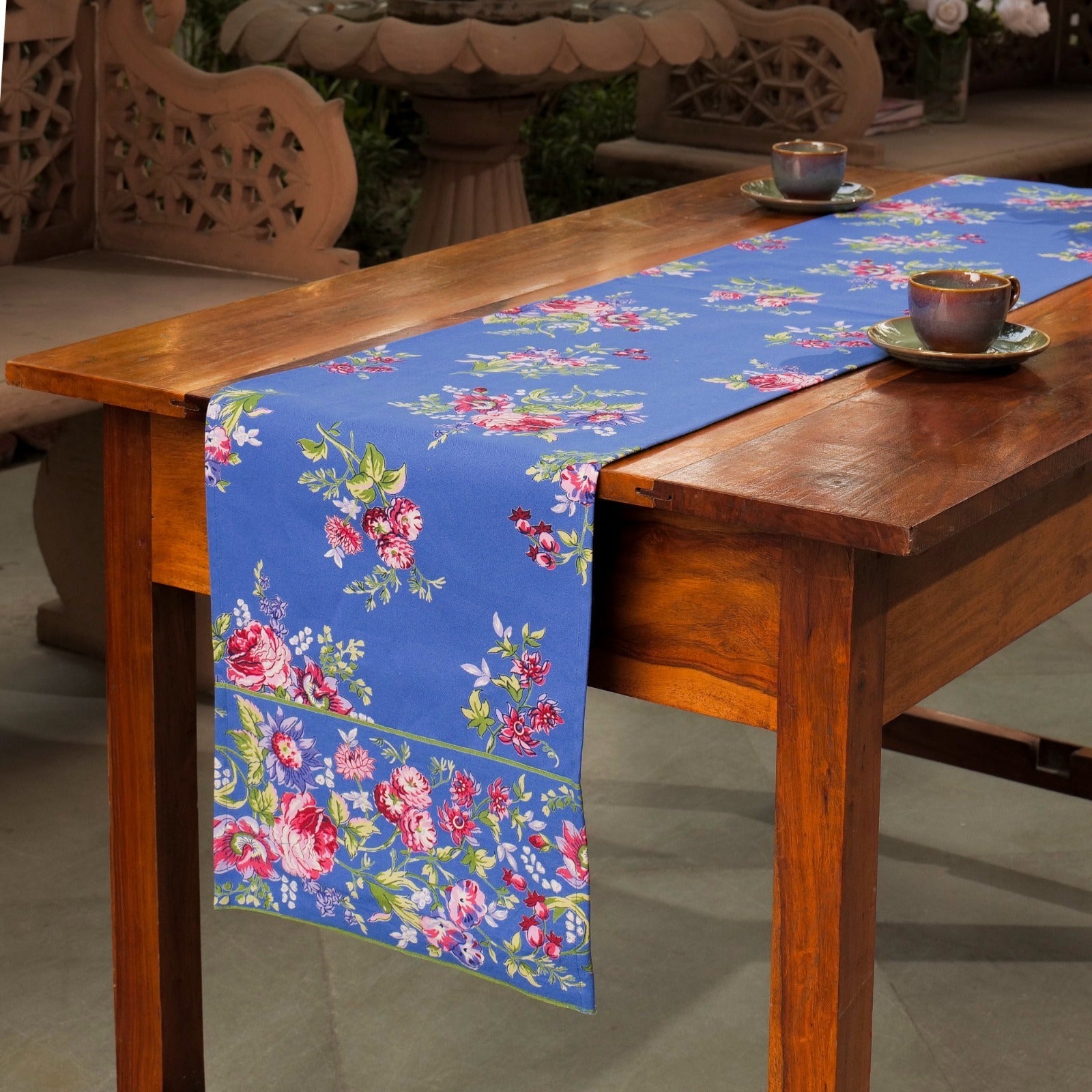
Runner on a bare table. The runner should complement the table surface rather than fight it. On a warm wooden table, a runner in a botanical or floral print in warm corals, terracottas, or deep greens works with the wood's natural warmth. On a glass-top table, a runner in a deeper, richer colour provides contrast against the transparency of the surface.
Runner over a tablecloth. One of the two should lead. If the tablecloth is printed, the runner should be in a plain or subtly textured fabric in a colour pulled from the tablecloth's palette. If the tablecloth is plain, the runner can carry the decorative work with a stronger print or texture. Two equally bold prints at the same scale fighting each other is the most common layering mistake and the one that produces the most visually exhausted result.
Runner and placemats together. When placemats are used alongside a runner, they sit on either side of it at each setting, between the runner and the table edge. The placemat and the runner should coordinate but not match exactly. Same palette, different print or texture. Or one plain and one printed. Six identical placemats from a coordinated set alongside a runner that picks up one of the same colours is the most reliable combination.
Runner and napkins. The napkin is at each individual setting, folded on the plate or beside it. The runner does not need to coordinate directly with the napkins beyond being in the same general colour family. A deep teal runner with soft coral napkins from the same warm palette works. A deep teal runner with unrelated grey napkins does not.
Two Runners: When and How
Using two runners instead of one is a legitimate and often better option in certain situations.
On a wide table. A standard 72 by 36 inch table has enough width for two runners placed lengthwise, one on each side of the centre, creating two parallel lines. This divides the table into a defined central zone flanked by two serving lines. Serving dishes go between or along the runners.
For a layered look. Two runners of different colours or textures crossed at right angles over a tablecloth creates a grid of four quadrants at the table's centre. Both runners meet at the midpoint of the table, which becomes the natural position for the centrepiece. This works particularly well on a square or round table where the geometry of the cross is symmetrical.
As placemat substitutes on a long table. Multiple runners laid widthwise across a long table, each one in front of two facing guests, act as shared placemats. Each runner defines a pair of place settings and the table is dressed without individual placemats. This is a contemporary arrangement that suits a casual dinner party or a communal meal where visual unity across the full length of the table matters more than individual place settings.
When using two runners, they should be the same runner or two that clearly belong together. Two different runners in unrelated prints on the same table compete for attention in a way that two runners in complementary colourways from the same palette do not.
Styling for Different Occasions
Everyday family meal. Runner centred on a bare wooden table. One or two low objects along it, a small plant, a candle, a bowl of fruit. Placemats at each seat on either side. Clean, relaxed, takes two minutes to set.
Dinner party. Runner over a plain ivory or neutral tablecloth. A printed runner in a warm tone over a plain cloth, or a textured jacquard runner over a printed cloth. A low centrepiece at the midpoint, flowers or candles. Placemats in a coordinating colour at each setting. Cloth napkins folded properly.
Festive occasion. A rich printed tablecloth as the base. A runner in a complementary jewel tone or a plain runner that picks up one colour from the tablecloth's print. The centrepiece at the midpoint can be more elaborate: a grouping of candles, a terracotta bowl of marigolds, a cluster of small vessels. The table reads as dressed for an occasion.
Bare-table everyday. Runner on its own, no tablecloth. Practical, low-maintenance, the runner is washed when needed and the table surface stays visible. Best suited to a table with a surface worth showing.
Frequently Asked Questions
How long should a table runner be? A table runner should overhang each end of the table by 6 to 15 inches. For everyday use, 6 to 8 inches is practical. For a dinner party, 10 to 12 inches looks more deliberate. To calculate the right length: measure the table's length and add twice the desired overhang. A 72-inch table with a 12-inch drop at each end needs a runner of at least 96 inches.
How wide should a table runner be? Standard table runners are 13 to 16 inches wide, covering approximately one third of the table's surface. This is the right proportion for most dining tables. For wider tables, two runners side by side or a single wider runner maintains better visual balance. For very small or narrow tables, a runner at 12 to 13 inches wide works better than a wider one.
Should a table runner be centred on the table? Yes. A table runner should be laid exactly down the centre of the table lengthwise, with equal overhang at both ends. Fold the runner in half to find its midpoint, lay it at the centre of the table, and unfold outward in both directions while keeping the overhang even. Step back and check from the end of the table to confirm alignment.
Can you use a table runner without a tablecloth? Yes. A runner on a bare table is one of the most common and effective ways to use one. It works particularly well on a beautiful wooden or glass-top table where showing the surface is desirable. It adds warmth and defines the serving zone without covering the table entirely.
How do you style two table runners? Two runners can be placed parallel lengthwise on a wide table, crossed at right angles over a tablecloth for a grid effect, or laid widthwise as shared placemats for two at each position on a long table. When using two runners, choose the same runner in matching or clearly complementary colourways so they read as a considered pair rather than two unrelated pieces.
What do you put on a table runner? A centrepiece placed at the midpoint of the runner: a low vase of flowers, a cluster of candles, or a bowl of seasonal fruit. For a meal, serving platters and shared dishes arranged along its length. The objects should accent the runner, not obscure it. Leave enough of the runner visible that it reads as the design element it is.
A table runner, placed correctly and coordinated well, does a significant amount of work for a small piece of fabric. It defines the centre of the table, gives serving dishes a home, frames whatever sits along it, and adds warmth and texture to the setting with minimal effort.
The key is proportion: the right length for the table, the right width for the surface, the right relationship with whatever else is on the table. Once those proportions are right, everything else follows.
Shop table runners at April Cornell India.