


Cart
0
-
April and May have a particular quality to them in Indian homes. The evenings stretch. Meals that were supposed to end at nine are still going at ten-thirty. Someone has pulled a chair from the living room. The mango season is at its peak and there is always a reason to eat together.
A dining table set with some care makes all of this better. Not in a way anyone announces, but in the way a well-dressed room makes a conversation easier. The conditions are right. People settle in.
What follows is a straightforward guide to setting that table: what to lay first, how each layer works, and the small decisions that separate a table that looks intentional from one that merely has food on it.
The Order Matters: Base First, Setting Second
Most people place the plate and build outward. The better sequence runs in the opposite direction. Lay the foundation of the table first and let the individual setting land on top of it.
Tablecloth down. Runner on top of that. Placemats at each seat. Then the plates, cutlery, and glasses. Each element frames what comes after it, and the table reads as composed rather than assembled.
The Tablecloth
For summer, cotton. Always cotton. It drapes without the stiffness of a synthetic, washes without the anxiety of a delicate fabric, and tolerates a cold glass or a spilled drink without looking immediately ruined.
On size: measure the table and add 20 to 24 inches to each dimension for a 10 to 12 inch drop on all sides. A standard six-seater in an Indian home (roughly 72 by 36 inches) needs a cloth of approximately 90 by 60 inches. A round four-seater at 48 inches across needs at least 68 to 72 inches of cloth. Too short and the table looks underdressed. Too long and it gets caught in the chairs all evening.
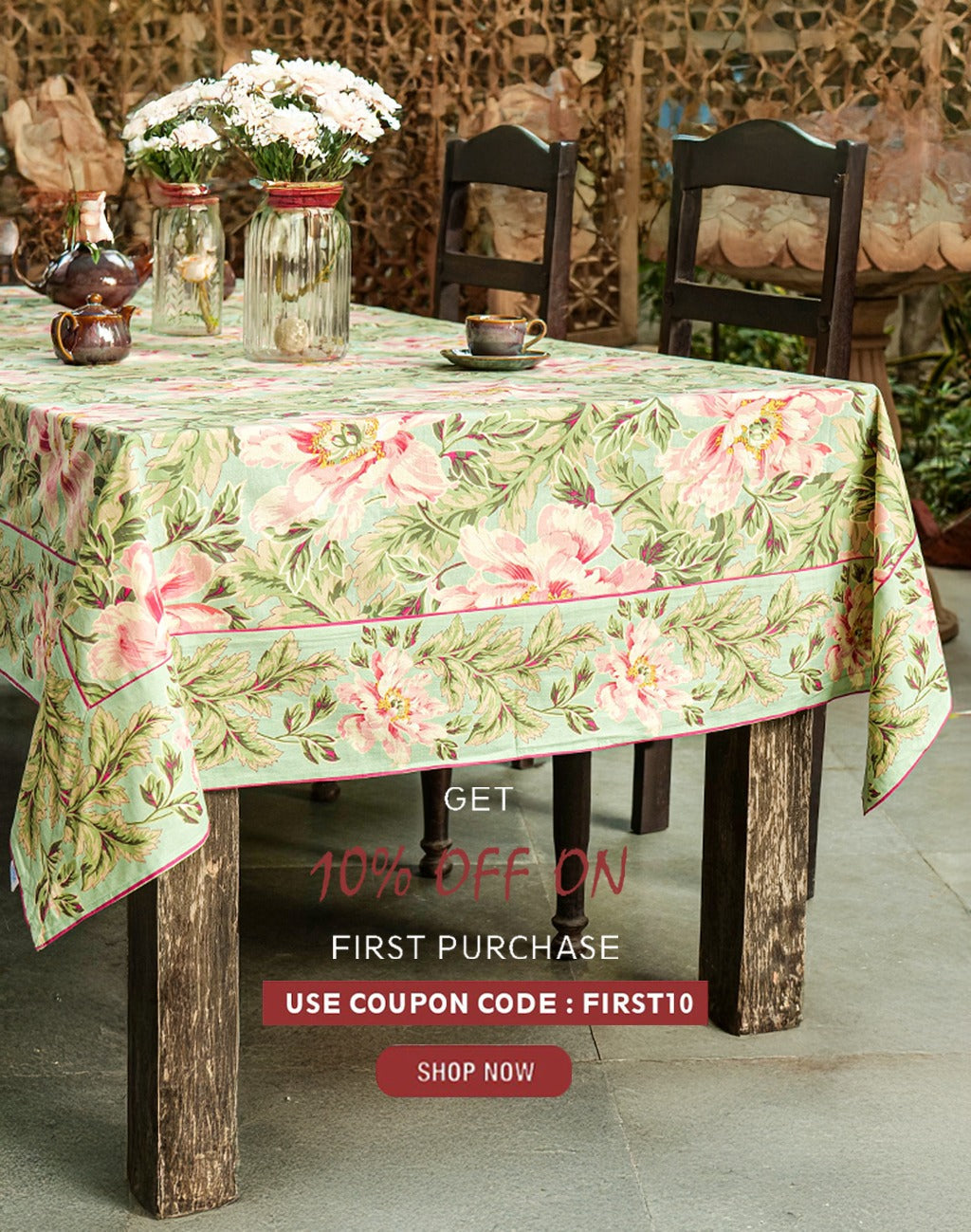
For a summer table, reach for a print rather than a plain. Botanicals, florals, and paisleys in corals, aquas, sage greens, and soft golds carry the season without needing anything else on the table to do the same work. The cloth sets the tone and everything above it responds to it.
The Table Runner
A runner down the centre of the tablecloth does something practical: it gives the food a home. Platters and serving bowls placed along it stay organised. The table holds its structure through a long meal rather than drifting toward chaos as the evening wears on.
Lay it lengthwise, centred, with 12 to 15 inches of overhang at each end. For a wide table or a family-style meal with several shared dishes, two runners crossed at right angles create a natural grid for the food and a more festive look overall.
For summer, a runner in a contrasting but complementary colour to the tablecloth works well. Against an ivory or white cloth, a deep printed runner in terracotta or indigo does most of the visual work. Against a coloured tablecloth, something quieter in a toning print holds the table together without competing.
Placemats
A placemat at each seat gives every guest a defined space at the table. It is a small thing with a disproportionate effect on how welcome people feel when they sit down.
Fabric placemats over hard plastic or cork for any meal that is expected to run long. They absorb condensation, they stay where placed, and they add texture and warmth to the setting in a way that a hard surface never quite does.
Choose a set that coordinates with the tablecloth without matching it exactly. The same colour family in a different scale of pattern, or a complementary colour pulled from the print of the cloth. Six matching placemats from a single set keeps the table coherent and eliminates the mixing-and-matching problem entirely.
One inch back from the edge of the table. Centred in front of each chair. Even spacing between them so the table reads as balanced. That is the full instruction.
Plates, Cutlery, and Glasses
The dinner plate goes in the centre of the placemat. Side plate above and to the left, or directly to its left if space is tight.
Forks to the left of the plate, knife and spoon to the right. The knife's cutting edge faces inward, toward the plate, always. Dessert cutlery, if being set in advance, lies horizontally above the plate, fork pointing right and spoon pointing left.
In most Indian homes, meals are shared and passed rather than plated formally. A single fork and spoon flanking the plate is entirely correct and considerably more practical than a full Western place setting. The cutlery should match the meal being served, not some theoretical ideal of formality.
Water glass directly above the knife. A second glass for juice or another drink sits to its right.
The Napkin
The napkin is last and it finishes the setting in the way a frame finishes a picture. Get it right and the whole table clicks into place.
Use cloth. A paper napkin against a properly set table is a visible mismatch. Not ruinous, but noticeable. Cloth napkins feel better, work better, hold a fold, and look correct in a way paper simply does not. A set of six in a warm summer print, gold or terracotta or a deep botanical, adds the last note of the season without requiring anything else.
Three folds, no expertise required:
The standing fold. Fold the napkin into a rectangle, then into thirds lengthwise. Stand it upright on the plate. Ten seconds per setting.
The diagonal tuck. Fold into a triangle, tuck half of it under the side plate with the point facing the guest. The pattern of the napkin stays visible. It looks more deliberate than it is.
The loose roll. Roll the napkin without pressing the folds flat and lay it across the plate or slip it through a napkin ring. The most relaxed option and entirely at home on a long summer evening.
The Centre of the Table
One element. Not several.
In summer, fresh flowers are the reliable choice, kept low enough that people can see each other across the table, in seasonal blooms picked up the same day. Marigolds, dahlias, or whatever is at the market in an earthenware or terracotta vessel sits naturally on an Indian summer table without looking arranged.
A bowl of seasonal fruit works just as well and costs less effort. Mangoes, lychees, a few passion fruits. The colours are already right for the season and a bowl of them on the table is both centrepiece and offering.
In both cases, keep the centre sparse enough that the tablecloth is still visible beneath it. A table that is crammed to the edges looks loaded. Some visible cloth, some breathing room, and the table looks considered rather than crowded.
Move the Drinks Elsewhere
Before guests arrive, take the drinks off the dining table. Set up a separate station on a sideboard or counter nearby. A cloth underneath, glasses, ice, water and whatever is being served. Guests pour their own.
The dining table stays clear for food. The setting remains visible through the meal. The evening runs without constant reorganisation of the surface.
Before Your Guests Arrive
-
Tablecloth down, even drop on all sides, no creases in the centre
-
Runner centred, equal overhang at both ends
-
Placemats one inch from the edge, one per guest, evenly spaced
-
Dinner plate centred on each placemat, side plate above or to the left
-
Forks left of the plate, knife and spoon right, cutting edge facing in
-
Water glass directly above the knife
-
Napkin folded on the plate or tucked at the side plate
-
Centrepiece low, placed along the runner, enough tablecloth visible around it
-
Drinks station set up separately
-
Spare napkins within reach of the table
Frequently Asked Questions
What is the correct way to set a dining table? Lay the tablecloth first, then the runner down the centre, then placemats at each seat. The dinner plate goes in the centre of the placemat. Forks to the left of the plate, knife and spoon to the right with the cutting edge facing in. The water glass sits directly above the knife. The napkin goes on the plate or to the left of the forks.
Where does the napkin go on a dining table? On the plate, to the left of the forks, or tucked under the side plate. In an informal setting, a rolled or loosely folded napkin resting on the plate is perfectly correct. Cloth napkins hold a fold better than paper and look more considered regardless of where they are placed.
What size tablecloth do I need for a 6-seater dining table in India? A standard six-seater in India measures approximately 72 by 36 inches. A tablecloth of 90 by 60 inches gives a 10 to 12 inch drop on all sides. A round four-seater at 48 inches across needs a cloth of at least 68 to 72 inches.
How do I decorate a dining table for summer in India? Start with a cotton tablecloth in a botanical or floral print in seasonal colours: coral, aqua, sage, or soft gold. Layer a contrasting runner down the centre, add fabric placemats in a coordinating print, and place a low centrepiece of fresh flowers or seasonal fruit along the runner. Leave enough tablecloth visible around the centrepiece so the table does not feel crowded.
What goes in the centre of a dining table? A single low element: a floral arrangement, a bowl of seasonal fruit, or a cluster of candles. The centrepiece should sit low enough not to interrupt conversation across the table. One considered element works better than several competing ones.
Do I need both a tablecloth and a table runner? No, but they work better together than separately. The tablecloth covers the full table. The runner defines the serving zone in the centre and adds a second layer of colour and texture. For a simpler look, a runner on bare wood works well. For a layered, more composed setting, both together is more effective.
Are cloth napkins worth it for home entertaining? Yes. They absorb better, feel better in the hand, and look correct against a good tablecloth in a way paper cannot. A set of six cotton napkins in a printed or coloured design lasts years. They also remove a recurring expense from every occasion that calls for them.
The Linen Cupboard Theory of Hosting
Good hosts are rarely born organised. They accumulate, quietly and over time, the few things that mean a table can be set well without an expedition to the market.
A tablecloth that fits the table they actually own. A runner in a print they genuinely like. A set of napkins that earns its place at every occasion from a weeknight family dinner to a summer evening that stretches past ten.
The summer evenings in April and May are worth preparing for. They do not announce themselves in advance. They simply happen. A table that is ready for them, without any drama about it, is a very good thing to have.
Shop tablecloths, table runners, placemat sets, and napkins at April Cornell India.
-