


Cart
0
-
The napkin fold is the last thing placed on the table before guests arrive and the first thing they move when they sit down. It occupies less than a minute of the setting-up process and has a visible effect on how finished and considered the table looks.
The five folds here require no practice, no starch, and no origami experience. Each one is described precisely enough to follow with a napkin in your hands, in sequence, without needing to watch a video. They are ordered from simplest to most impressive, so if you are reading this with guests arriving in twenty minutes, start at the top.
Before You Start: One Useful Tip
All five folds work better on a napkin that has been ironed. A fresh-from-the-wash, unironed napkin will hold some folds loosely and let others collapse. Two minutes with an iron on a cotton setting, while the napkin is still slightly damp, produces a crisp, flat surface that holds every fold cleanly.
If you have no time to iron, the loose roll and the diagonal tuck both forgive a slightly unironed napkin. The standing fold and the fan require a crisper surface to hold their shape well.
Fold 1: The Rectangular Lay
The simplest fold and the one that looks exactly right on a plate for a casual or everyday dinner.
-
Open the napkin completely flat on the table in front of you.
-
Fold it in half so you have a rectangle, bringing the bottom edge up to meet the top edge.
-
Fold it in half again in the same direction so you have a smaller rectangle.
-
Fold it once more, this time from side to side, so you have a square approximately one quarter the size of the original napkin.
-
Lay it in the centre of the plate with one of the folded edges facing the guest and the open corners tucked away underneath or at the back.
That is the complete fold. It takes under thirty seconds, looks clean and intentional, and works for any table from a family Sunday lunch to a formal dinner. The simplicity is the point.
Fold 2: The Diagonal Tuck
The fold most commonly seen at well-dressed restaurant tables. It looks more deliberate than the rectangular lay without being any more complicated.
-
Open the napkin completely flat on the table.
-
Fold it diagonally in half, bringing one corner to meet the opposite corner. You now have a triangle.
-
Position the triangle with the long folded edge nearest to you and the single point facing away.
-
Fold the right corner of the triangle over to the left, so it sits roughly two-thirds across the napkin. Press the fold down.
-
Fold the left corner over to the right in the same way, so it overlaps the first fold. Press down. You now have a narrower, layered triangle.
-
Tuck the bottom half of this folded triangle under the side plate, with the single pointed end facing toward the guest.
The result is a napkin that sits at the left of the place setting with its point facing outward toward the guest. The layered fabric is visible and the pattern of a printed napkin shows clearly. It takes under a minute once done twice.
Fold 3: The Standing Fold
The fold that stands upright on the plate and catches the eye across the table. More impressive in appearance than in execution.
-
Open the napkin flat on the table.
-
Fold it in half by bringing the bottom edge up to the top edge. You have a rectangle.
-
Fold the rectangle into thirds lengthwise: take the left third and fold it to the centre, then take the right third and fold it over the top. Press both folds firmly.
-
You now have a long, narrow rectangle, approximately one third as wide as the original napkin.
-
Hold the rectangle with the open edges at the top and the folded edge at the bottom.
-
Stand it upright on the plate, with the narrow folded edge as the base. It will hold its shape when placed on a flat surface with even pressure.
The standing fold works best on a napkin that has been ironed. If it topples, fold it once more from the bottom up to widen the base slightly. Place it in the centre of the plate with the open edges facing upward.
Fold 4: The Loose Roll
The most relaxed of the five folds and the right choice for a casual dinner party or a long, unhurried evening where formality is not the goal.
-
Open the napkin flat on the table.
-
Fold it in half diagonally, bringing one corner to the opposite corner. You have a triangle.
-
Starting from the long folded edge at the base of the triangle, roll the napkin upward loosely toward the pointed tip, without pressing the roll flat or folding it tight.
-
Leave the last few inches unrolled so the tip of the triangle is loose and visible at one end.
-
Lay the roll horizontally across the centre of the plate, or slip it through a napkin ring if you have one.
The loose roll has a relaxed, generous quality that suits an informal setting well. On a printed napkin, the pattern appears at both ends of the roll and along its length, which makes the most of a good print.
Fold 5: The Fan
The fold that makes the most visual impact and works particularly well for a festive occasion or a dinner party where the table has been dressed with care.
-
Open the napkin completely flat on the table.
-
Starting at one short end of the napkin, fold the fabric back and forth in accordion pleats, each pleat approximately one inch wide. Continue pleating until the entire napkin has been folded this way.
-
You now have a long, narrow pleated strip.
-
Fold this strip in half at the midpoint, so the two ends of the strip meet. Hold the folded midpoint firmly between your fingers.
-
The pleats at the top of the fold will fan outward if you release them gently. Hold the folded midpoint together and allow the pleats above it to spread into a fan shape.
-
Either place the folded midpoint into a wine glass or a tall water glass, with the fan spreading above the rim, or tuck the folded midpoint under the side plate so the fan stands upright and spreads outward toward the guest.
The glass presentation is the more dramatic of the two. The under-plate presentation is tidier and works well at a closely set table where glasses are already in position.
The fan fold takes two to three minutes to do well the first time. By the third napkin it takes under a minute. It is worth practising once before guests arrive so the pleats are even.
Which Fold for Which Occasion
The choice of fold is partly aesthetic and partly practical, depending on how much time is available and how formal the occasion is.
Everyday family dinner: The rectangular lay. Fast, flat, completely correct, asks nothing of the napkin.
Casual dinner party: The loose roll or the diagonal tuck. Both look deliberately placed without requiring elaborate preparation.
Formal dinner party: The standing fold or the fan. Both signal that the table has been dressed with attention. The standing fold is quicker. The fan is more impressive.
Festive occasion: The fan in a glass, with a printed napkin in a rich seasonal colourway. The pattern of the napkin fans outward above the rim of the glass and the effect is considerable for the effort involved.
A Note on Printed Napkins and Folds
A plain napkin looks well in any fold. A printed napkin requires a little more consideration, because different folds reveal different amounts of the print.
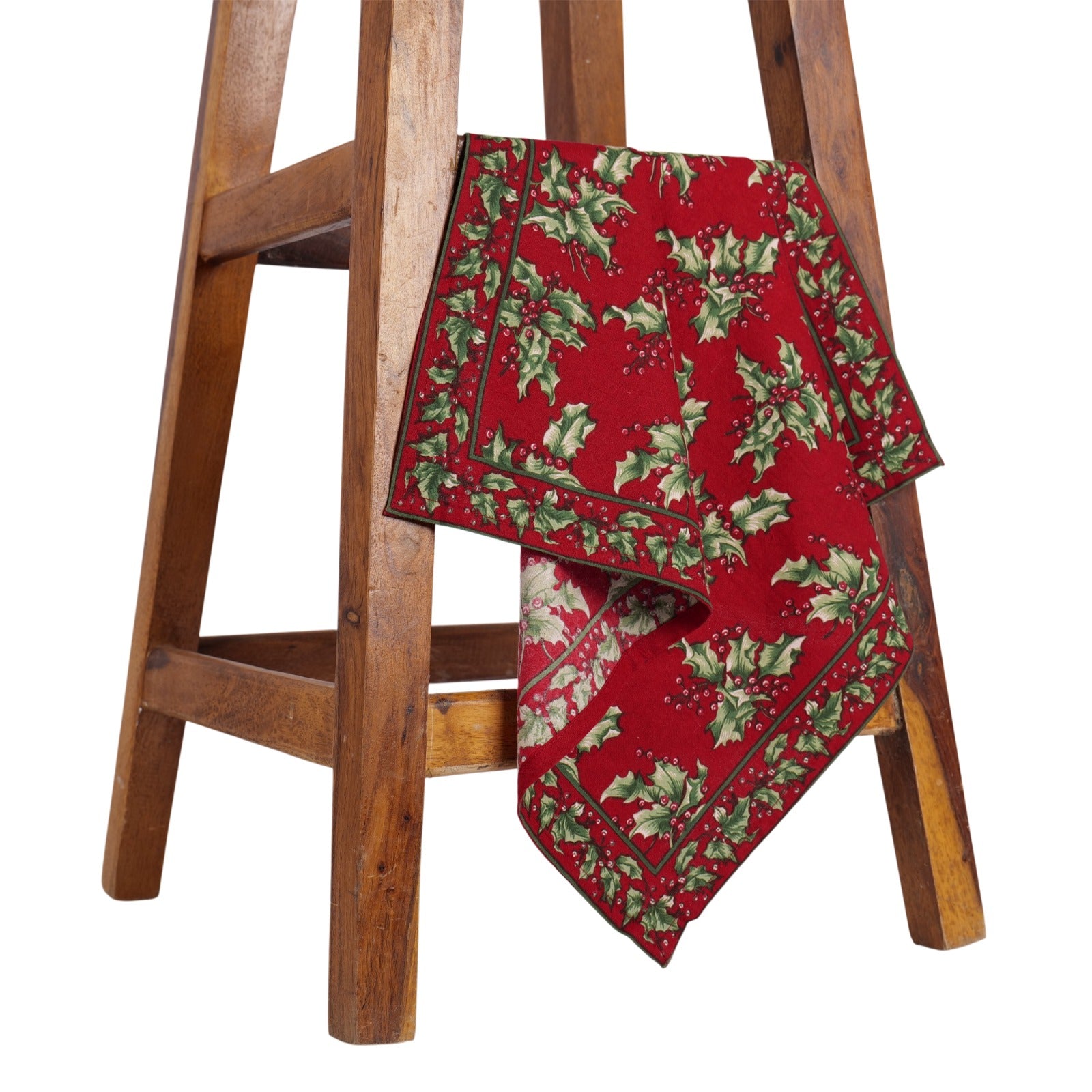
The diagonal tuck shows the print clearly at the visible triangle face. The loose roll shows it along the length and at both ends. The fan shows it across the full spread of the pleats. The standing fold shows very little of the print because the napkin is folded tightly.
For a set of napkins in a print you particularly like, the diagonal tuck, the loose roll, and the fan all make more of the pattern than the standing fold or the rectangular lay. Choose the fold that lets the napkin show what it has.
Frequently Asked Questions
What is the easiest napkin fold for a dinner party? The rectangular lay is the easiest: fold the napkin in half, fold again to a smaller rectangle, fold once more to a square, and lay it on the plate. Under thirty seconds, looks clean and intentional at any table. For a slightly more impressive result with the same level of effort, the diagonal tuck adds one extra step and shows more of the napkin.
How do you fold cloth napkins to stand up on a plate? The standing fold: fold the napkin in half to a rectangle, then fold lengthwise into thirds to make a narrow rectangle, and stand it upright with the folded edge as the base. It holds its shape on a flat surface. An ironed napkin holds this fold considerably better than an unironed one.
How do you fold a napkin into a fan shape? Accordion-pleat the napkin from one short end to the other, each pleat approximately one inch wide. Fold the resulting strip in half at the midpoint and either tuck it into a glass or under the side plate so the pleats fan outward above the holding point.
Should napkins be ironed before folding? For most folds, yes. An ironed napkin produces crisp, flat edges and holds its fold better than an unironed one. The standing fold and the fan in particular benefit significantly from being ironed first. The loose roll and the diagonal tuck are more forgiving of a slightly unironed napkin.
How long does napkin folding take? The rectangular lay and the diagonal tuck each take under thirty seconds per napkin once done twice. The standing fold and the loose roll take about a minute each. The fan takes two to three minutes the first time and under a minute once the technique is familiar. Six napkins for a dinner party table takes fifteen minutes at most for all five styles.
Which napkin fold works best with a printed napkin? The diagonal tuck, the loose roll, and the fan all show the print well. The diagonal tuck places the printed face outward toward the guest. The loose roll shows the pattern along its length. The fan spreads the print across the full width of the pleats. The standing fold and the rectangular lay keep most of the print hidden inside the fold.
A folded napkin is not a performance. It is a small, practical gesture: the table has been prepared for the people about to sit at it. Any of these five folds communicates that clearly, in the time it takes to do it.
Start with the rectangular lay if the table needs to be set in the next ten minutes. Work up to the fan once a dinner party is being approached with a little more lead time. Both belong on the same table.
Shop cotton napkin sets at April Cornell India.
-